Friday, September 5, 2014

REPOST: Roger Federer Serves Like a Girl

A new pattern has emerged when Sabine Lisicki broke the record for fastest serve during the Bank of the West Classic at 131mph. This article from Slate.com discusses how women tennis players serve faster than their male counterparts.


Sabine Lisicki serves to Maria Sharapova during their women's singles third-round match of the 2014 U.S. Open on Aug. 29, 2014, in the Flushing, Queens. | Image Source: slate.com


A month ago at the Bank of the West Classic, Germany’s Sabine Lisicki hit a serve 131 miles per hour—the fastest ever recorded in women’s tennis.

That’s not just fast for a woman. Lisicki’s record-setting shot—which broke Venus Williams’ mark of 129 mph—is faster than any serve Roger Federer has hit in 2014, according to statistics provided to me by the Association of Tennis Professionals.

Lisicki, who lost in the third round of the U.S. Open to Maria Sharapova, stuck around long enough to blast the speediest serve of any woman at this year’s U.S. Open (124 mph). That’s just barely slower than the best effort in the Open of top men’s seed Novak Djokovic (125 mph) and equal to or better than the fastest serves of at least 29 men, including seeded players Kei Nishikori, Richard Gasquet, David Ferrer, Guillermo García-López, and Mikhail Youzhny. (I say at least 29 men because not every player in the men’s and women’s singles draw played on a court equipped with a serve-measuring radar gun. Also, a necessary caveat: There has been some dispute about the accuracy of tennis radar gun measurements.)

Serena Williams’ top serve at this year’s Open (122 mph) has also outpaced that of Ferrer (119 mph), García-López (118 mph), and Youzhny (117 mph). And women can compete with the men on average first-serve speed as well. Serena Williams’ average (108 mph) in her quarterfinal match against Flavia Pennetta was better than that of No. 12 men’s seed Gasquet (104 mph) in his third-round loss to Gaël Monfils. And No. 10 seed Nishikori, a U.S. Open semifinalist, has an average first-serve speed of 108 mph—the same as Serena’s highest—in three of his five matches thus far.

In a recent column on hard-throwing Little Leaguer Mo’ne Davis, the Washington Post’s Sally Jenkins argued that cross-gender comparisons risk making the world’s best female athletes look like failures. Indeed, it would be silly to argue that Lisicki and Serena Williams’ fast-serving feats aren’t all that impressive because certain men, like Milos Raonic and John Isner, can serve a whole lot faster. But what’s fascinating about the tennis serve is that the gender gap is so narrow by comparison with other athletic endeavors. And sometimes, as in the cases of Sabine Lisicki and world No. 5 David Ferrer, the gender gap gets flipped completely.

In his excellent book The Sports Gene, David Epstein points out that there’s long been speculation that women might catch up to men in athletic performance—for instance, a 1992 article in Nature asked, “Will Women Soon Outrun Men?” Given that women have only recently been encouraged to participate in sports, it was natural that elite female athletes would improve at a rapid clip. Epstein argues, however, that after the initial boom in women’s sports, “the biological gap is expanding.” In track and field events, he writes, “the top 10 men at any distance … are about 11 percent faster than the top ten women ... [and] in the long jump, women are 19 percent behind men. The smallest gap occurs in distance swimming races. In the 800-meter freestyle, top women are within 6 percent of top men.”

And then there’s tennis. The overlap between men’s and women’s serving speeds in the ball-and-racket sport isn’t totally unique. In golf, the top three women on theLPGA tour in average driving distance—Lexi Thompson, Gerina Piller, and Brittany Lincicome—all outdrive the last man on the PGA Tour’s driving distance scoreboard, Paul Goydos. But there is far more overlap with tennis serves, where someone like Lisicki can crank it faster than many of the world’s best male players.

Golf and tennis have something in common: Players impart force to the ball by swinging a piece of equipment. Do the rackets explain the rocketing serves of top female pros? In a piece on ESPNW.com, the global tour manager for Wilson tells Johnette Howard that he thinks improved racket technology isn’t a huge factor—that improved training and technique “are contributing to higher ball speeds more than a racket change has.”

Or is it the balls? Forbes’ Allen St. John claims that women are serving so well at the U.S. Open because they’re playing with a different ball than the men are, one that flies more quickly. But the data don’t support that conclusion—or at the very least don’t support the idea that the ball explains everything. At Wimbledon, where men and women do play with the same ball, 20 women served 111 mph or faster. At the U.S. Open, 20 women have served 112 mph or faster. The fastest serve by a woman at Wimbledon in 2014 (Madison Keys’ 123 mph strike) was just one mile per hour slower than the fastest serve by a woman at this year’s U.S. Open. (David Ferrer’s fastest serve at Wimbledon in 2014? 118 mph.) And Serena Williams’ fastest average first-serve speed in any Wimbledon match in 2014 (106 mph) was just two miles per hour slower than her fastest average speed so far at the U.S. Open.


Tom Phanco is a big tennis fan. Get the latest updates from his favorite sport by following him on Twitter.

Friday, August 29, 2014

Tennis: A great sport for all ages

Image Source: .nytimes.com


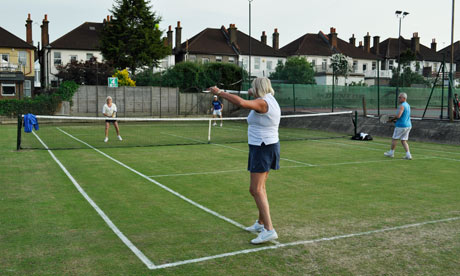
Tennis is an intensive sport that exercises the entire body. Since it requires two to four players, the fun factor often masks the rigorous activity the muscles receive. As such, most tennis experts advise younger people to participate in this sport to prevent injury. Nevertheless, many people in their 50s are starting to take up this sport, despite many hesitations and discouraging remarks.

Admittedly, older adults should take more care in doing physical activities, but these should not prevent them from engaging in sports, particularly those that can be properly observed and commented on. Professional tennis can reach fast-paced speeds but these can be dramatically reduced for recreational purposes. The focus of tennis for fun should be more on form rather than numbers. This is a great way for beginners to practice their techniques with their friends or coaches, and becomes particularly important for players of a certain age. Learning, understanding, and practicing good form lessens the risk of injury and encourages flexibility.


Image Source: theguardian.com


Keeping an active lifestyle has been suggested to add years to a person’s life because it strengthens one’s immune system which prevents them from getting sick. Sports have also been shown to improve quality of life through decreased stress and (in team sports) creating new friendships. People over 50 have also reported having a greater sense of well-being, along with improved sleep and increased daytime vitality after engaging in a physical sport such as tennis. These data considerably suggest that participating in sports is beneficial for any one, at any age.


Image Source: victoriaparktennis.co.uk


Tom Phanco is a tennis enthusiast who wants to encourage everybody to share his passion for the sport. Learn more about him by following him on Twitter.

Wednesday, July 23, 2014

REPOST: Back from Exile: Viktor Troicki Returns to Tennis

After a long break from the world of Tennis, Viktor Troicki returns to the court, determined and ready to redeem himself. Read about his interview from Tennis.com below.

The Serb's last match took place last July in Umag, which passed on giving him a wildcard for his return. | Image Source: tennis.com
“The tough part is that I’m starting from zero,” Viktor Troicki says as he wraps up a practice session in the sleepy alpine town of Gstaad, which plays host to this week’s Swiss Open, the scene of his comeback from a controversial 12-month doping ban. “I won’t have any protected ranking or anything so that’s going to be hard. But I’ve made it to the top once so I’m ready to do it again.”

Troicki pauses. His statement of intent is imbued with a quiet determination, stemming from the events of 2013 which he and many others still regard as a deep injustice.

Wind back 15 months to the 2013 Monte Carlo Masters. Troicki had just been comprehensively outplayed in the first round, but as a matter of procedure, he still needed to complete a blood test. It’s a routine process for most players, but Troicki has a deep-seated phobia of needles which makes every test a trauma. Feeling unwell, he requested it to be postponed to the following morning.

Troicki and his team say that the on-site doping control officer agreed, he took the test next day, and thought nothing more of it. As with every other test taken throughout his career, the results returned negative. But to his horror, two days later he received an email from the ITF informing him that he faced a potential two-year ban for allegedly refusing to take the test on time.

Three months later, he was banned from tennis for 18 months. An ITF tribunal panel refuted his claim that their official had told him he could postpone it. "Her response was that this was not a matter upon which she could advise the player," the panel said.

Looking back, Troicki is still in disbelief at how the trial proceeded. “It was amazing how the lawyers were going really hard for the maximum suspension,” he says. “I’m a tennis player and yet this was coming from the International Tennis Federation for whom I’ve played a lot of tournaments. That was really disappointing. I made my name through tennis and then they do this to me.”

He turned to the Court of Arbitration for Sport, but when the hearing took place in October, it came down to his word against the ITF. Lacking requisite evidence to overturn the ban altogether, it was merely reduced to 12 months.

“The funny thing is that the doctor who gave me the wrong instructions, she continued working,” he says. “She just continued doing her job and that’s because she doesn’t have rules. We players have rules and she just has instructions to follow. For me that’s kind of silly. She made a mistake and she hasn’t been sanctioned by anyone.”

Troicki’s feelings were shared by Novak Djokovic. The pair have known each other since Djokovic was eight years old, and at last year’s World Tour Finals he released an emotional statement in support of his friend.

“He gave me the most support out of all the players,” Troicki said. “He’s shown that he’s a great friend and even though he faced problems because he was supporting me, he still stood by me and tried to help as much as he could. He was one of the first guys to publicly support me and I will never forget that.”

Image Source: tennis.com

Not everyone was on his side. Andy Murray hit out at Troicki and Marin Cilic, who was also banned for four months for accidentally ingesting a banned stimulant, accusing them of “unprofessionalism,” a move which infuriated Cilic’s coach, Goran Ivanisevic.

“The players have to be more like a family,” Ivanisevic said. “Troicki’s case is ridiculous. He’s now having to start from zero. From zero, for a crime he didn't commit. It’s a f***ing joke because it’s the official’s word against his and they believe her, not him. And the ATP doesn’t do anything even though they’re supposed to protect the players. If you cheat I’m for banning, but come on, for this? You can’t put everybody in the same basket. It’s not fair.”

In Troicki and Ivanisevic’s eyes, he is a victim of sporting politics. Sport has been wrestling with the dark spectre of doping for some time, but for many years, while an almost endless sequence of big-name positive tests brought baseball and cycling almost to their knees, tennis remained relatively immune.

But Lance Armstrong’s long-awaited confession last January cast a shadow which sent shivers through the entire sporting universe. Suddenly there were hints that tennis may too have something unpleasant lingering in the closet. Murray and Rafael Nadal expressed surprise that they hadn’t been tested more. Many players called for the ITF to introduce the same biological passport system being implemented in cycling.

Troicki believes the federation was simply waiting for an opportunity to ease the pressure, to show everyone they were taking doping seriously. “I feel they wanted to use me, to put me down for a long time to set an example,” he said. “My tests were always negative and they know that. I’ve always been against any kind of doping and use of illegal substances. I’ve done a lot of tests and I’ve never even thought about taking something illegal. Even this year while I’ve been banned they’ve tested me a lot of times.”

Image Source: tennis.com

Now 28, Troicki is currently ranked No. 847 in the world. He faces a long slog through the backwaters of the game, playing the kind of events he thought he left behind a decade earlier.

There will be few wildcards to ease the journey back. Instead of heading to North America for the upcoming hard-court swing culminating in the U.S. Open, Troicki will spend his summer competing in a series of Challenger tournaments, amongst the journeymen and the hungry young upstarts, all keen to take the scalp of a player once ranked 12th in the world.

Even finding a place to launch his comeback was not easy. As a former semifinalist, Troicki initially hoped for a wildcard into this week’s ATP event in Umag, but he was overlooked in favor of three Croatian juniors before Gstaad eventually answered his plea.

The draw, pitting him against rising Austrian star Dominic Thiem, epitomized the struggles he will face to return to the top of the game. A year is a long time in sport and a new wave of talented youngsters are starting to emerge. Troicki knows he will have to be patient.

“I’m not expecting everything to happen straight away. There’s going to be a bit of pressure but I haven’t played any official tournaments for a year. I don’t know how good I’ll be against the top guys. I might need two matches or I might need three tournaments to get things started.”

Image Source: tennis.com

There will undoubtedly be difficult times on the road ahead, but Troicki does not have to look far for motivation. He remembers last year’s Davis Cup, when he was banned from attending Serbia’s training camp during both their semifinal and final ties, and even from being present inside the stadium.

“It was kind of ridiculous what they were doing to me. I just wanted to watch it as a normal spectator but the Serbian federation told me that the ITF were really putting pressure on them. They didn’t want me in the stands, in the arena at all. They even wanted to put my photo on each door of the arena like a criminal to say that I was forbidden to be there.”

However, the ITF say they did not choose to deliberately ban Troicki from the Davis Cup ties.

"It was not an ITF decision not to allow Troicki to attend the final," they informed TENNIS.com. "The WADA code and therefore the Tennis Anti-Doping Programme rules do not allow any suspended player to attend any event covered by the program."*

The idea of practicing for months on end without a goal is a crippling prospect for any professional, but Troicki drew on the support of his coach and physio who stuck by him despite receiving multiple alternative offers.

“They felt really down in the beginning, they felt for me you know, and that’s why they want to continue working with me, get me back on the right track. My coach wants me to be even better than I was. That means a lot to me.”

Troicki brightens as he describes his team’s attempts to put a positive spin on his predicament. He feels it may actually aid his longevity as a player. Lasting 11 months of the year, the tennis circuit is relentless and most players admit they can ill-afford to take more than a week off from training. Even holidays are booked only in the knowledge that a tennis court is nearby. So after more than a decade as a professional, he was finally able to recharge.

Image Source: tennis.com

“I took the chance to do all the things I hadn’t been able to do while I was playing tournaments,” he said. “I was skiing a lot in the winter. I was hanging out with my friends, just trying to forget about what happened to me. It was hard at first to begin working again, but I’ve been working really hard on my condition and as time went on I became more motivated and more pumped to come back. I realize what I’ve missed.”

But bitterness can also be a powerful motivation, and even as he talks through the benefits of relaxation, that lingering sense of injustice is never far from the surface.
“I will always feel that,” he says. “Of course. The ITF tried to destroy my career and I will never forget what happened. In the court they really went after me and they really wanted to put me down and ruin me completely. But I hope to show them they were unable to do that. I will be back.”

Subscribe to this Tom Phanco Facebook page to get more news about tennis.

Monday, June 30, 2014

Diet tips for tennis players

Image Source: happyherbivore.com

A healthy diet contributes to a player’s peak performance. Whether it is for a club championship or practice, what is good for the health is also generally good for the player.

Image Source: wsj.com

Tennis superstar Novak Djokovic, for example, credits his success to a strict diet of mostly warm foods. Mardy Fish, on the other hand, has ditched eating pizzas and burgers to become slimmer and sleeker, which he credits for his mobility.

Following this, the International Tennis Federation (ITF) promotes “Eating Right” as a way to improve performance, delay feelings of fatigue, and reduce a player’s vulnerability to injury and illness. The ITF lays out the following tips for tennis players:

Image Source: anokhimedia.com

• For pro players or for those who actively play tennis, a person is predicted to need between 3500 to 5000 calories a day.

• Players are encouraged to consume four primary nutrient categories, including fluids, electrolytes, carbohydrates, and protein.

 • Best liquids and beverages include water, seltzer, club soda, mineral water, flavored water. Players, however, should stay away from diuretics like caffeinated beverages and alcohol.

 • Carbohydrates—found in cereal, bread, pasta, potatoes, rice, legumes, and fruits, vegetables, and sports products—should represent approximately 60 percent of the calories in one’s diet.

• Proteins, those that are easy to digest like fish and vegetables, help players recover between matches. Players are encouraged to consume protein within 30 minutes after tennis play.  

Learn more about tennis by visiting this Tom Phanco YouTube channel.

Saturday, May 31, 2014

REPOST: Tennis-Federer through to Halle semis without hitting a ball


Defending champion Roger Federer make it to the semifinals of the Halle grasscourt championships last Friday without appearing on court. Find out why in this UK Reauters article


Image Source: uk.eurosport.yahoo.com


(Reuters) - Roger Federer reached the semi-finals of the Gerry Weber Open without hitting a ball on Friday after Lu Yen-hsun of Taiwan pulled out because of a back injury in Halle, Germany.

Elsewhere, Rafa Nadal's conqueror Dustin Brown was knocked out after he lost a final set tiebreak 18-16 against fellow German Philipp Kohlschreiber.

Fourth seed Kei Nishikori of Japan beat American Steve Johnson 6-1 7-6 (4) and Colombian Alejandro Falla ousted home player Peter Gojowczyk 7-6 (4) 7-6 (2).

Seventeen-times grand slam champion Federer made up for the walkover by continuing his preparations for Wimbledon with an exhibition match against Germany's Christopher Kas who is ranked 78th in doubles.

Lu joked: "If I'm 150 percent and he's 100 percent I think I'd still lose".

Six-times Halle winner Federer now faces Nishikori in the semi-finals.

Brown captured the imagination of the crowd on Thursday with a convincing win over world number one Nadal but failed to match that form as he lost a marathon match against Kohlschreiber.

The wildcard looked on course for another victory, leading 5-2 in the tiebreak, but the German number two kept his cool to save five match points and secure a meeting with Falla.

"I don't think a third set ever went so long," said 2011 winner Kohlschreiber. "Absolute war of nerves.

"It was very exhausting to keep calm, stay cool and maybe even enjoy it. The atmosphere was incredible but in the end you just want to leave the court as the winner." (Reporting by Tom Hayward, editing by Tony Jimenez)

This Tom Phanco Twitter page offers tennis news from around the world.

Wednesday, April 30, 2014

REPOST: Nick Kyrgios wins Challenger tennis tournament in Georgia

Kyrgios defeated American young gun Jack Sock in Savannah Challenger. Read more from this Abc.net.au article
****
Australian teenager Nick Kyrgios has celebrated his 19th birthday with a tournament win on the ATP's secondary Challenger tour, his second title in as many weeks. 
Image Source: en.wikipedia.org

Kyrgios defeated American Jack Sock 2-6, 7-6, 6-4 on Monday to lift the trophy at the Challenger event in Savannah, Georgia.
It was his second straight tournament victory on American green clay following his triumph at the Sarasota Challenger in Florida the previous week, and takes his winning streak to 10 matches.
 Image Source: tennis.com.au
"Awesome couple of weeks, nice rewards for the whole team and our hard work. Couldn't have asked for much more. Nice Bday pressie too!!," he tweeted after the match.
He also said that he had picked up a slight abductor strain in the win over Sock, but hopes to be fit for the next Challenger tournament in Florida next week.

 Image Source: atpworldtour.com
Tom Phanco is a fan of tennis. To know more about him and his sport, visit this Linkedin page.

Friday, March 14, 2014

REPOST: Tennis Trivia

Tennis is played by million recreational players. Although it's a very popular game, there are tidbits about it that a lot of people still don't know. This article shares trivia about the sport.
****

A selection of tennis trivia and useless facts, inspired by the longest tennis match in history played at the 2010 Wimbledon tournament.

 Image Source: commons.wikimedia.org
  • The longest tennis match in history was played between between American John Isner and Frenchman Nicolas Mahut at Wimbledon on June 22-24, 2010. The first-round match took 11 hours and 5 minutes over three days, lasting so long it was suspended because of darkness two nights in a row. The match was won by Isner 6-4, 3-6, 6-7 (7), 7-6 (3), 70-68. The fifth set was the longest set in history as determined by both duration and number of games (8 hours 11 minutes, 138 games) and the set itself would have broken the previous longest match record of 6 hours 33 minutes. The longest women's tennis match was played in 1984 between Vicki Nelson and Jean Hepner at the 'Ginny of Richmond' tournament in Richmond, Virginia. That match took 6 hours, 31 minutes with a score of 6–4, 7–6(11), and featured a 29-minute, 643-shot rally - the longest in professional tennis history.
  • Possibly the shortest tennis match is the match that lasted just 20 minutes, when Susan M. Tutt beat Marion Bandy 6-0, 6-0 at the Wimbledon tournament in 1969.
Image Source: businessinsider.com
  • The US Open was known as the Patriotic Tournament in 1917 during World War I.
  • The strings or guts of the tennis racket have in the past been made out of a cow and sheep guts.
  • The French Open is named after the stadium it is played in, which is in turn named after a World War I pilot named Roland Garros.
  • Boris Becker became the first unseeded player to win Wimbledon in 1985 when he was only 17 years old. He also became the youngest player to win the title, as well as the first German.
 Image Source: hdwpapers.com
  • The open era of tennis started in 1968. The first Grand Slam to go open was the French Open.
  • Two Australian Open tournaments were held in 1977, when changing from a January event to a December event - the first in January, the second in December. In 1987, the tournament moved back to January, so no championship was decided in 1986.
  • Tennis was first played at the Olympics in 1896, but was removed from competition after the 1924 games. It was played as a demonstration sport in 1968 and 1984, then re-introduced as an actual event for the 1988 Olympic Games.
 Discover more exciting topics about tennis by visiting this Tom Phanco Twitter page.